

Scaffolding systems form the critical infrastructure of modern construction, providing temporary access and support structures for personnel and materials. At the core of these systems is the scaffolding plank, also known as a scaffold board or deck. While timber boards were the historical standard, the global construction industry has overwhelmingly transitioned to steel scaffolding planks. This shift is driven by strict safety regulations, the need for predictable load-bearing capacities, and long-term economic returns. Steel planks deliver exact dimensional tolerances, eliminate the risks of internal rot and catastrophic brittle failure, and offer superior fire resistance in industrial environments.
Understanding the technical specifications, metallurgical requirements, and the complex manufacturing process is essential for scaffolding suppliers, construction contractors, and manufacturers evaluating capital equipment investments. This comprehensive technical guide details the engineering principles behind steel scaffolding planks and provides an in-depth analysis of the continuous cold roll forming process used to produce them.
Global Regulatory Standards and Compliance Requirements
The design and manufacturing of scaffolding planks are governed by stringent international standards to ensure worker safety under dynamic and static loads. In the European framework, EN 12811-1 (Temporary works equipment - Scaffolds) defines the performance requirements and methods of structural and general design. The standard categorizes scaffold platforms into six load classes. Classes 1 through 3 are intended for inspection and light duty, while Classes 4, 5, and 6 are engineered for heavy-duty masonry and industrial work, requiring significant uniform distributed load (UDL) capacities.
In the United States, the Occupational Safety and Health Administration (OSHA) Standard 1926.451 Subpart L mandates that scaffold platforms must be capable of supporting, without failure, their own weight and at least four times the maximum intended load applied or transmitted to them. Deflection is also strictly controlled; most international engineering codes stipulate that the deflection of a platform must not exceed 1/100 of the span when subjected to the concentrated design load.
To meet these rigorous criteria, manufacturers cannot rely on arbitrary designs. The geometric profile of the plank, the yield strength of the raw material, and the precision of the manufacturing process must be tightly controlled and validated through continuous destructive testing, including center point load tests and drop impact tests.
Material Specifications: Steel Grades and Corrosion Protection
The structural integrity of a scaffolding plank begins with the selection of the correct steel coil. Because planks operate in aggressive outdoor environments exposed to moisture, concrete alkalis, and mechanical abrasion, the material must possess both high yield strength and robust corrosion resistance.
Yield Strength and Mechanical Properties
Standard scaffolding planks are typically manufactured from structural grade carbon steel. In Asian manufacturing sectors, Q235B (yield strength ≥ 235 MPa) and Q345B (yield strength ≥ 345 MPa) are the dominant grades. The European equivalents are S235JR and S355JR. The choice of grade directly influences the required thickness of the steel. Utilizing a higher yield strength steel, such as Q345B, allows manufacturers to achieve the requisite moment of inertia and load capacity using a thinner gauge (e.g., 1.5 mm instead of 1.8 mm), thereby reducing the overall dead weight of the scaffold structure and lowering material costs.
Galvanization and Coating Mass
Corrosion protection is achieved exclusively through hot-dip galvanization. The raw material is procured as pre-galvanized steel coil conforming to standards such as EN 10346 or ASTM A653. A zinc coating mass of Z275 (275 grams of zinc per square meter, total both sides) is the standard specification for construction equipment. In highly corrosive environments, such as chemical plants or offshore platforms, heavier coatings or advanced zinc-aluminum-magnesium alloy coatings may be specified. The roll forming process must be carefully calibrated to ensure that the bending stresses do not cause micro-cracking or flaking of this protective zinc layer.
Structural Geometry and Cross-Sectional Profile Design
The load-bearing performance of a steel plank is dictated by its cross-sectional geometry. Unlike flat plates which would easily buckle under load, scaffold planks are engineered as deep channel sections with complex boxed or returned edges.
Standard Dimensions
Market requirements dictate standard widths, typically 210 mm, 225 mm, 240 mm, 250 mm, and 300 mm. The height (or depth) of the plank usually ranges from 38 mm to 50 mm. The deeper the section, the higher the moment of inertia, which exponentially increases the bending stiffness and reduces deflection over longer spans (which commonly range from 1.0 meter up to 4.0 meters).
Rib Stiffeners and Boxed Edges
To prevent local buckling of the broad, flat upper surface under point loads (such as a worker's boot or stacked materials), longitudinal stiffening ribs are formed into the web of the profile. Furthermore, the side flanges do not simply terminate; they are bent inward and upward to form a hollow, rigid box section along both longitudinal edges. This boxed edge design provides extreme torsional rigidity and eliminates sharp edges that could cause hand injuries during manual handling on the construction site.
Anti-Skid and Drainage Perforations
The surface of a steel scaffolding plank must provide a high coefficient of friction to prevent slipping in wet or muddy conditions. This is achieved by punching specific hole patterns into the flat web before roll forming. The primary anti-skid features are upwardly extruded holes with jagged or flanged edges that grip footwear. Interspersed between these raised features are standard downward-punched holes. The downward holes serve a critical function: drainage. Preventing water accumulation is essential, as pooled water adds dangerous dead weight to the scaffold structure and drastically reduces surface traction.
The Continuous Roll Forming Production Process
Industrial scale manufacturing of scaffolding planks requires a highly synchronized production line. The process involves transforming a flat, heavy coil of steel into a complex, perforated, cut-to-length structural member at speeds of 10 to 20 meters per minute.
Uncoiling and Leveling
The process begins with a heavy-duty hydraulic decoiler that supports and unwinds the steel coil. A precision leveling machine (or straightener) follows, utilizing a series of offset staggered rollers to remove coil set and internal stresses from the steel strip. A perfectly flat strip is mandatory to ensure accuracy in the subsequent punching and forming stages.
High-Speed Servo Punching
Before the strip is bent, it passes through a mechanical or hydraulic punching press equipped with a complex die set. Controlled by a servo feeder, the press actuates rapidly to punch the alternating pattern of upward anti-skid flanges and downward drainage holes. Because the material is pre-galvanized, the punching dies must be manufactured from high-grade tool steel (such as Cr12MoV, hardened and precision ground) to minimize burrs and protect the zinc coating around the perforations.
Cold Roll Forming
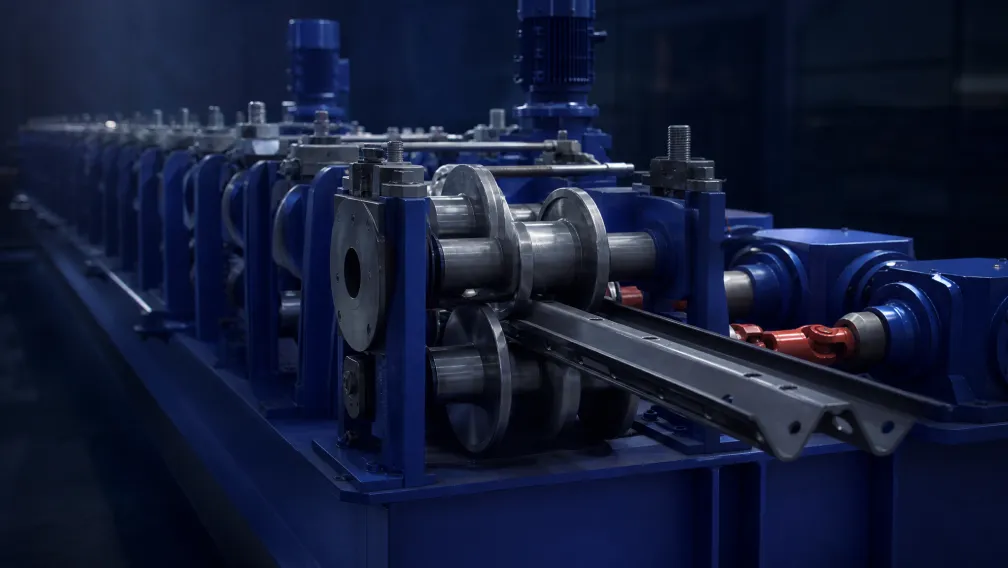
The perforated strip enters the core of the line: the roll forming mill. This section consists of 18 to 24 sequential roll stations. Each station incrementally bends the steel, beginning with the longitudinal stiffening ribs in the center, and progressively forming the vertical side flanges and the complex boxed returns. By distributing the deformation across multiple stations, the process prevents material stretching, limits springback, and ensures dimensional stability. The fundamental mechanics of this stage are identical to those detailed in our guide on what a cold roll forming machine is.
Hydraulic Tracking Shear
Once the final profile is achieved, the continuous plank must be cut to specific lengths without halting production. A hydraulic flying shear, or a tracking shear driven by a servo motor, moves synchronously with the extruded plank, clamps it, and drives a custom-profiled cutting blade through the cross-section. The blade profile exactly matches the finished boxed cross-section of the plank to guarantee a clean cut without crushing or deforming the edges.
Quality Control Protocols and Maintenance
Producing structural components for human support mandates a zero-tolerance approach to manufacturing defects. Quality control begins at the decoiler, where laser micrometers continuously verify the incoming coil thickness. Any deviation below the specified tolerance (e.g., dropping below 1.45 mm for a nominal 1.50 mm coil) compromises the final load capacity and must be flagged automatically by the PLC system.
During the roll forming process, the primary failure mode is profile distortion, specifically bow (vertical curvature), camber (horizontal curvature), and twist. These dimensional anomalies are generally caused by uneven roll pressure, improper clearance settings, or inherent residual stresses in the incoming coil. Operators mitigate these issues using a specialized straightening block or turks head positioned immediately after the final roll station. This tooling applies precise counter-pressure to true the profile before it enters the cutting shear.
Routine maintenance of the roll forming equipment is equally critical. The Cr12MoV punching dies and D2 steel forming rollers require periodic inspection for wear and galling. Because the zinc coating is relatively soft, it can accumulate on the rollers over time. This zinc buildup increases the effective diameter of the rollers, altering the bending radius and potentially causing scratches on subsequent planks. Scheduled cleaning, precise lubrication of the punching tools, and verifying the alignment of the forming shafts using dial indicators are mandatory procedures to maintain the integrity of the finished scaffolding planks.
Equipment Selection: Analyzing the Roll Forming Line
For manufacturers looking to establish or upgrade their production capabilities, selecting the right machinery is the most consequential technical decision. A comprehensive scaffolding plank production line must balance production speed, profile accuracy, and changeover efficiency.
One of the primary challenges in scaffold plank production is managing different profile widths (e.g., switching from a 210 mm width to a 240 mm width). In traditional machinery, this required completely disassembling the roll stations and swapping out the heavy roller dies, resulting in hours or days of costly downtime.
Modern engineering solves this via advanced machine configurations. A high-end scaffolding steel plank roll forming machine utilizes a dual-cantilever or duplex structure with motorized width adjustment. In this system, one side of the forming mill is fixed, while the entire opposite side moves laterally on precision linear guides via a motorized screw mechanism. This allows the operator to adjust the machine for a new plank width in minutes through the PLC touch screen. Alternatively, cassette-style roll forming machines utilize interchangeable rafts, where the entire tooling set can be lifted out via crane and replaced with a pre-assembled raft for a different profile, maximizing machine uptime.
Secondary Operations: End Hook Assembly
While the continuous roll forming line produces the main body of the plank, many scaffolding systems require connection hooks at both ends to secure the platform to the tubular ledger. These end hooks, along with connecting brackets, are typically manufactured offline using dedicated stamping presses.
Following the cut-to-length stage, the planks are moved to an assembly cell. Here, the heavy-duty end hooks are inserted into the open ends of the boxed profile. They are permanently secured using robotic CO2 shielded arc welding or high-strength structural riveting. The welding parameters must be strictly controlled to achieve full penetration without burning through the relatively thin gauge of the plank web, and the welded areas are subsequently treated with zinc-rich cold galvanizing compound to restore corrosion protection.
Conclusion and Procurement Strategy
The manufacturing of steel scaffolding planks represents a demanding application of cold forming technology. The combination of structural engineering, metallurgical science, and precision machinery results in a product capable of safely supporting immense loads in hostile environments. For construction equipment suppliers, ensuring product compliance requires rigorous attention to material grades, profile geometry, and continuous quality control. For manufacturers, investing in a robust, highly automated roll forming line equipped with servo-punching and motorized width adjustments is the key to maintaining strict dimensional tolerances while achieving the throughput necessary for commercial success in the global construction market.
If you are planning to upgrade your manufacturing infrastructure or require consultation on customized roll pass designs for proprietary scaffold profiles, THRONCH engineering teams are available for detailed project assessments. Contact us directly to specify your ideal production line configuration.
-

THRONCH
Cold Roll Forming Machine Manufacturer
THRONCH is a direct manufacturer specializing in custom cold roll forming lines and welded pipe mills. With over a decade of engineering expertise, we share technical insights and deliver high-precision