

Global utility-scale solar installations are undergoing a significant material transition in the second half of 2026. The widespread migration from traditional post-hot-dip galvanized steel to continuously coated zinc-aluminum-magnesium (Zn-Al-Mg) alloy steel coils has expanded across major markets in the Middle East, Europe, and North America. While Zn-Al-Mg coatings deliver superior cut-edge self-healing protection and lower total lifecycle costs, the material introduces distinct tribological and mechanical behaviors that necessitate specific adjustments in cold roll forming tooling and production line architecture.
Deformation Characteristics and Surface Friction
The addition of aluminum and magnesium elements into the zinc bath forms a eutectic microstructure consisting of Zn, Al, and MgZn2 phases. This composition achieves higher surface hardness compared to conventional pure zinc coatings, which fundamentally alters the contact mechanics between the steel strip and the forming rolls:
- Galling and Tooling Wear: Due to the higher mechanical resistance of the alloyed coating, inadequate roll finish or incorrect clearance frequently results in localized adhesive wear (galling) on roller dies.
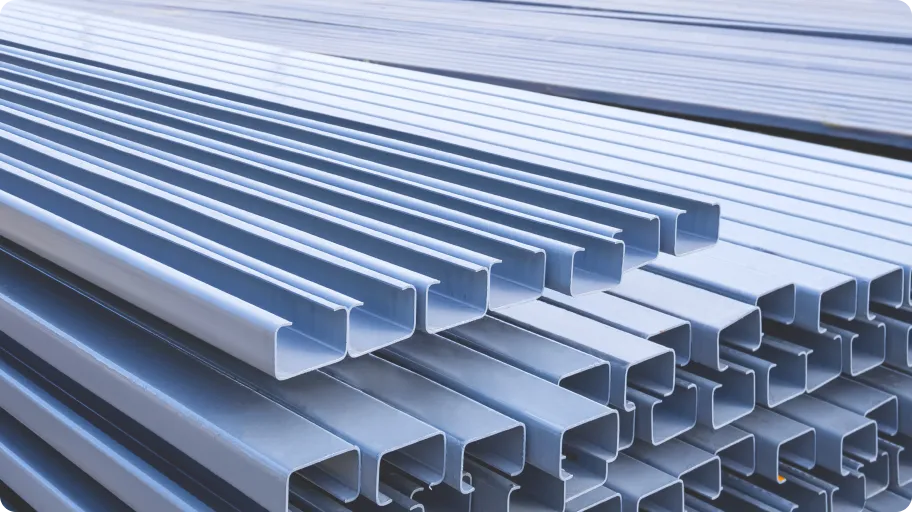
- Micro-Cracking at Bend Radii: In heavy-gauge solar purlin and torque-tube production (thickness exceeding 3.0 mm to 4.5 mm), aggressive bending angles induce localized tensile stress, increasing the risk of microscopic coating delamination along outer profile corners.
- Springback Variability: High-strength substrate grades typically paired with Zn-Al-Mg coatings (e.g., S350GD through S550GD) exhibit pronounced elastic recovery following cold deformation, complicating profile dimensional consistency across variable coil batches.
Line Configuration and Roller Tooling Optimization
Accommodating the metallurgical parameters of Zn-Al-Mg coated strip requires precise technical adjustments across the mechanical forming stations.
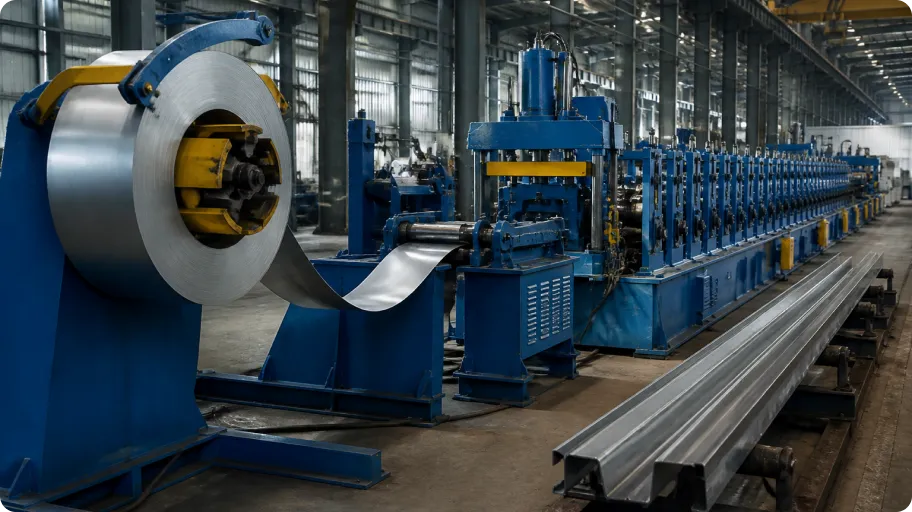
First, progressive deformation distribution is critical. Rather than utilizing aggressive angle increments across limited forming passes, the line configuration requires an extended series of forming stations with smaller, incremental angular steps. Spreading deformation across 18 to 26 forming passes diminishes localized shear stress and prevents coating layer fracturing.
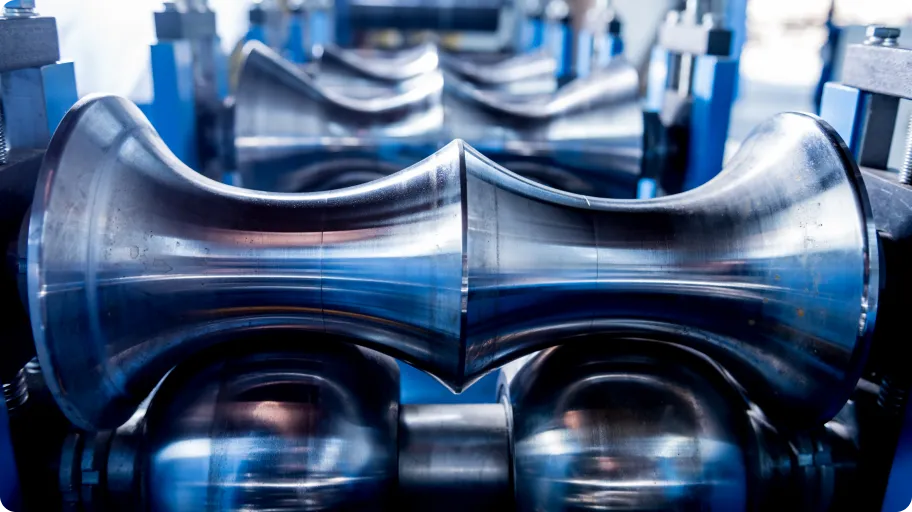
Second, tooling metallurgy and surface treatment must be upgraded. Forming rollers utilized for Zn-Al-Mg steel typically demand high-chromium alloy tool steels (such as Cr12MoV, DC53, or D2), vacuum heat-treated to 58–62 HRC. Subsequent mirror polishing followed by hard chromium electroplating (minimum thickness 0.05 mm) or physical vapor deposition (PVD) titanium nitride coating is applied to lower the friction coefficient below 0.15, thereby mitigating alloy pickup and scrap generation.
Customized Tooling Integration at Tonghe Machinery
As solar component manufacturers scale production to meet revised grid-scale specifications, equipment adaptability remains essential. Tonghe Machinery engineers custom roll forming production lines specifically configured for high-strength, Zn-Al-Mg coated steel applications. By optimizing roller flower designs via finite element simulation and integrating servo-driven straighteners with automated hydraulic punching, our equipment ensures precise cross-sectional tolerances and uncompromised surface integrity for heavy-duty solar brackets and tracker components.
-

THRONCH
Cold Roll Forming Machine Manufacturer
THRONCH is a direct manufacturer specializing in custom cold roll forming lines and welded pipe mills. With over a decade of engineering expertise, we share technical insights and deliver high-precision