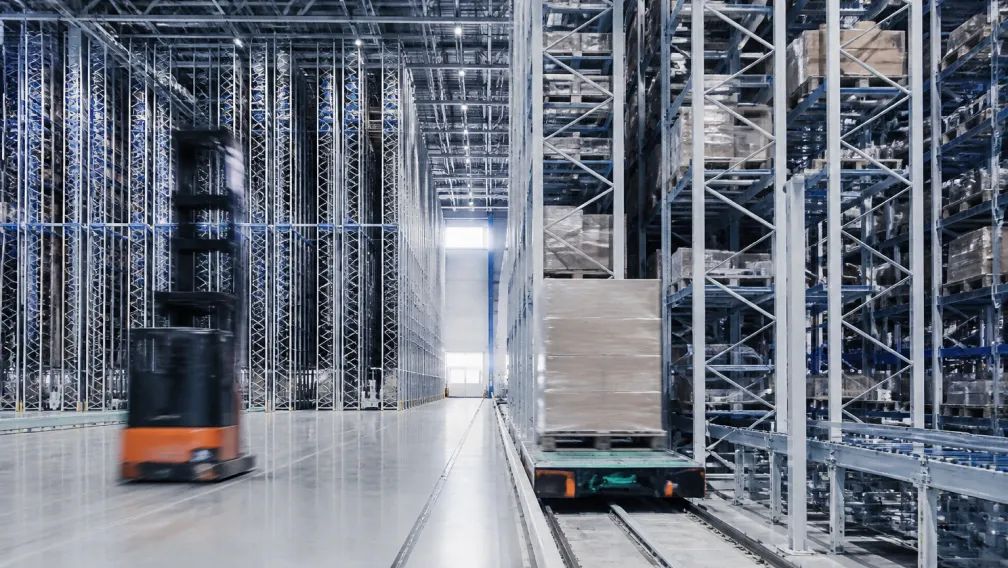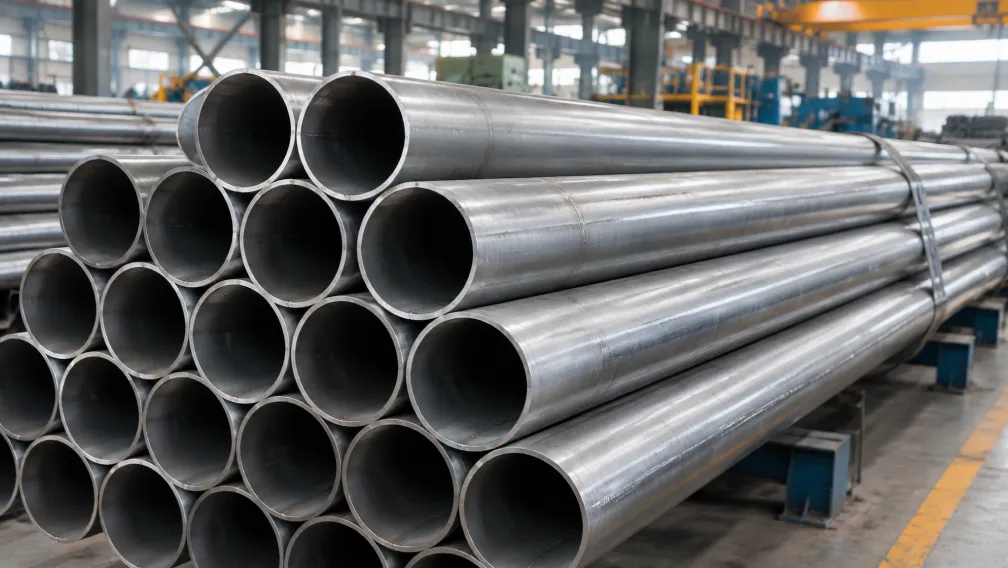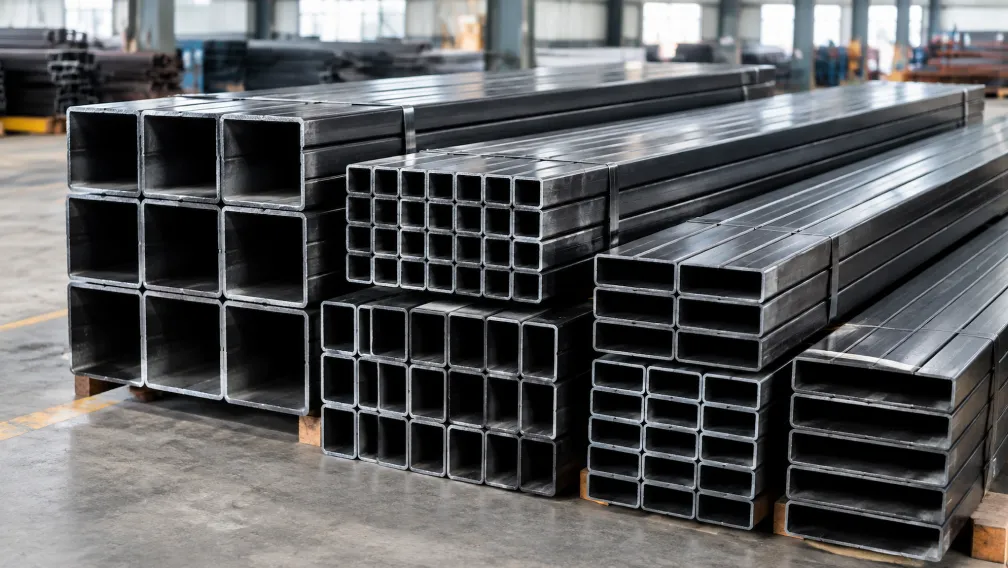


E-commerce logistics and cold chain warehousing have driven an unprecedented expansion in high-density storage infrastructure. Automated Storage and Retrieval Systems (ASRS) and traditional selective pallet racking require structural frameworks engineered to extreme tolerances. The backbone of these systems consists of steel upright frames and horizontal load-bearing step beams. Unlike standard structural steel, warehouse racking relies on thin-gauge, high-strength cold-formed profiles that maximize the strength-to-weight ratio. Producing these components with strict dimensional accuracy is critical, as minor deviations in hole pitch or profile twist will compromise the automated shuttle systems and lead to catastrophic structural failure under dynamic forklift loading.
Understanding the metallurgical inputs, structural geometry, and precision continuous cold roll forming process is essential for racking manufacturers scaling their production. This technical guide examines the engineering standards governing pallet rack components and details the industrial roll forming mechanics required to manufacture teardrop uprights and step beams at high velocity.
Global Racking Standards and Load Engineering
The design and manufacture of industrial steel storage racks are regulated by international engineering codes that dictate safety factors, steel thicknesses, and testing protocols. In North America, the Rack Manufacturers Institute (RMI) sets the ANSI/MH16.1 standard, which governs the design, testing, and utilization of industrial steel storage racks. This standard mandates rigorous testing for column buckling, beam deflection, and connection rigidity between the upright and beam.
In the European market, EN 15512 provides the principles for structural design of steel static storage systems. A critical requirement across all standards is deflection control. For step beams, the maximum vertical deflection under a uniform distributed working load is typically restricted to 1/180 of the clear span. For upright columns, axial compression and torsional buckling are the primary failure modes. To meet these structural demands without adding excessive dead weight, manufacturers rely on complex cross-sectional geometries achieved exclusively through cold roll forming.
Material Specifications: High-Strength Low-Alloy Steels
The load capacity of a storage rack is directly tied to the yield strength of the substrate coil. Standard commercial quality steel is inadequate for modern high-bay racking. Manufacturers typically specify High-Strength Low-Alloy (HSLA) structural steels. Common grades include Q235B and Q345B (yield strength ≥ 345 MPa) in Asian markets, and S355JR or SS400 internationally. For seismic zones or ultra-high ASRS facilities exceeding 30 meters, advanced grades like S420MC or S460MC are increasingly utilized.
These materials are processed either as hot-rolled pickled and oiled (HRPO) coils, which require post-fabrication powder coating, or pre-galvanized coils (such as Z275) for cold storage and outdoor applications. The use of high-yield steel introduces significant springback during the forming process. Consequently, the roll pass design must over-bend the material at specific stations to compensate for elastic recovery, requiring sophisticated finite element analysis (FEA) during the tooling engineering phase.
Profile Geometry: Uprights and Step Beams
The performance of a rack system depends entirely on its profile shape.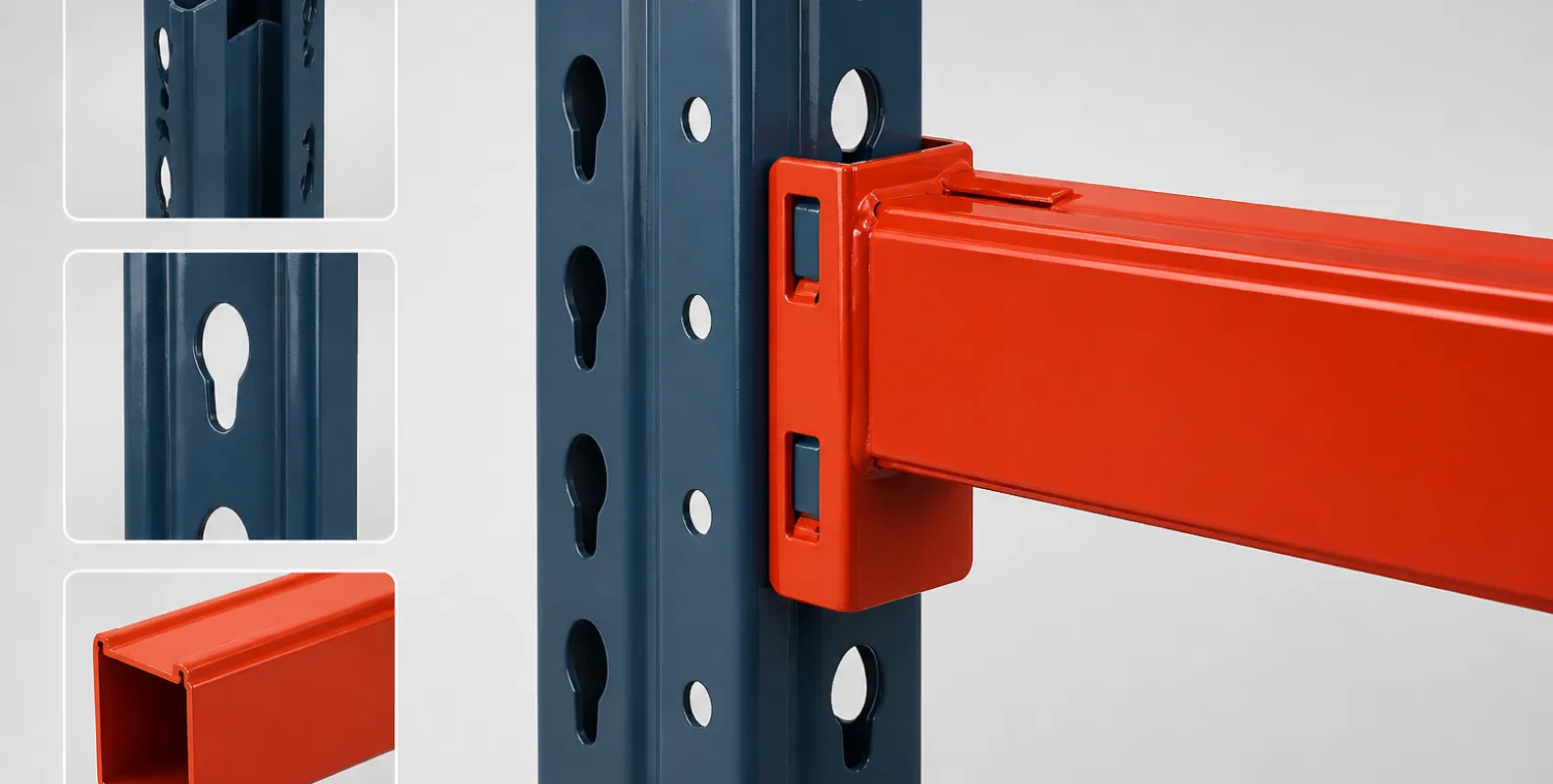
The Upright Column
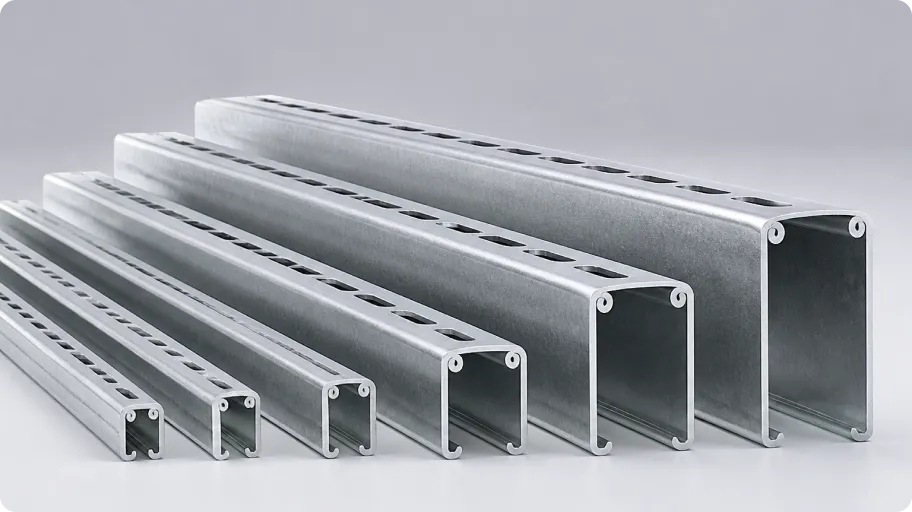
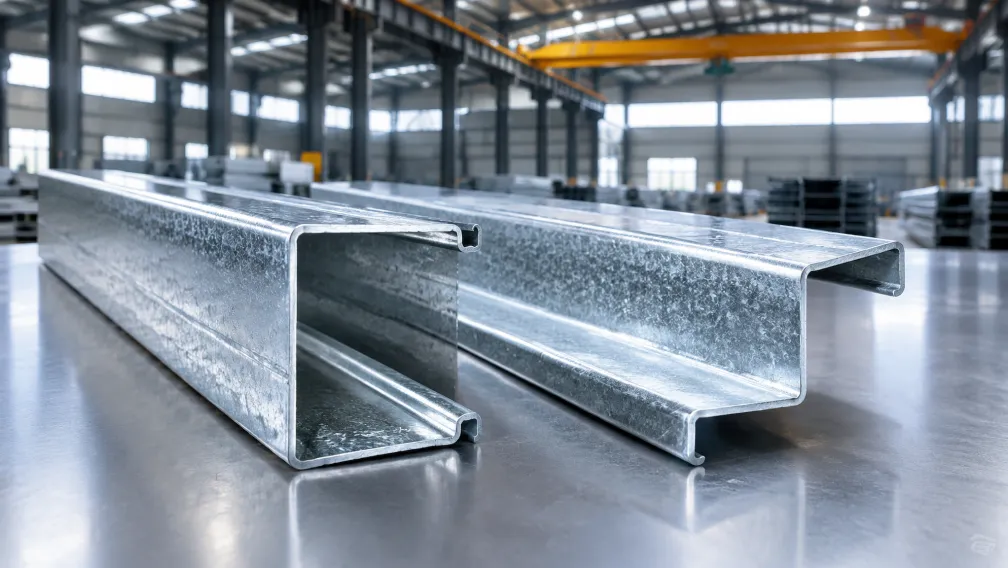
The upright (or column) is typically formed into an "Omega" or modified C-channel profile with multiple return flanges. The frontal face contains a continuous series of punched slots—the most ubiquitous being the "teardrop" pattern in the US, or rectangular/hexagonal keyholes in Europe. These perforations allow the step beams to engage and lock at variable heights, usually in increments of 50.8 mm (2 inches). The return flanges at the rear of the profile provide torsional rigidity and are pierced with circular holes to bolt the diagonal and horizontal bracing matrix. Common face widths range from 75 mm to 120 mm, with material thicknesses from 1.5 mm to 3.0 mm.
The Step Beam
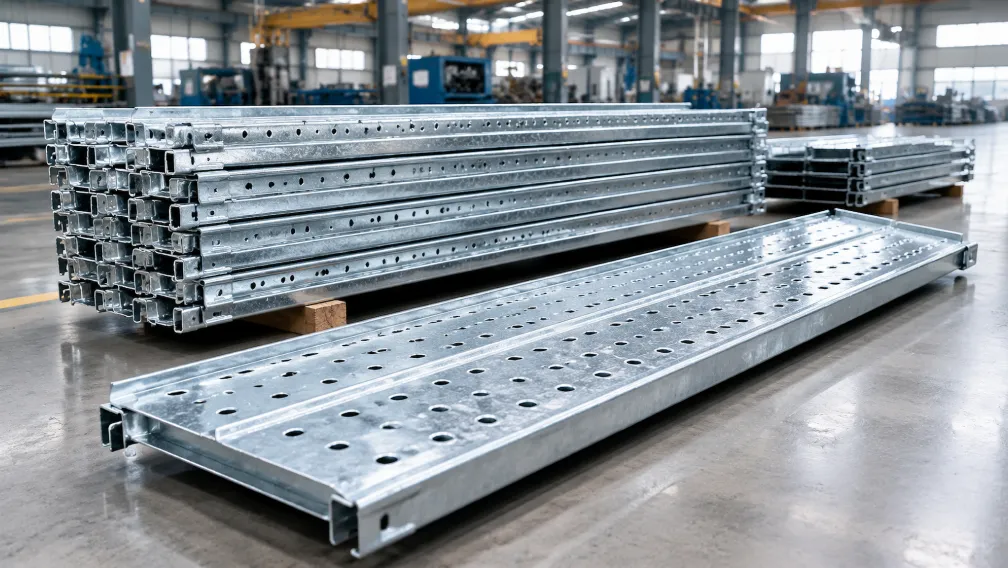
Step beams span horizontally to support the pallet loads. They are manufactured in two primary configurations: the roll-formed tubular step beam and the interlocking box beam. A step beam features an integrated ledge (the "step") on the inner face, designed to seat wire decking, crossbars, or wooden panels flush with the top of the beam. To achieve a closed tubular section via cold forming, the edges of the strip are folded inward to interlock, or they are continuously seam-welded in-line. The closed box geometry resists torsional rotation when loaded asymmetrically by a forklift.
The Continuous Roll Forming Production Line
Manufacturing rack components profitably requires a high-volume, fully synchronized storage rack production line. The process integrates uncoiling, precision servo punching, cold forming, and flying shear technologies into a seamless operation running at 15 to 25 meters per minute.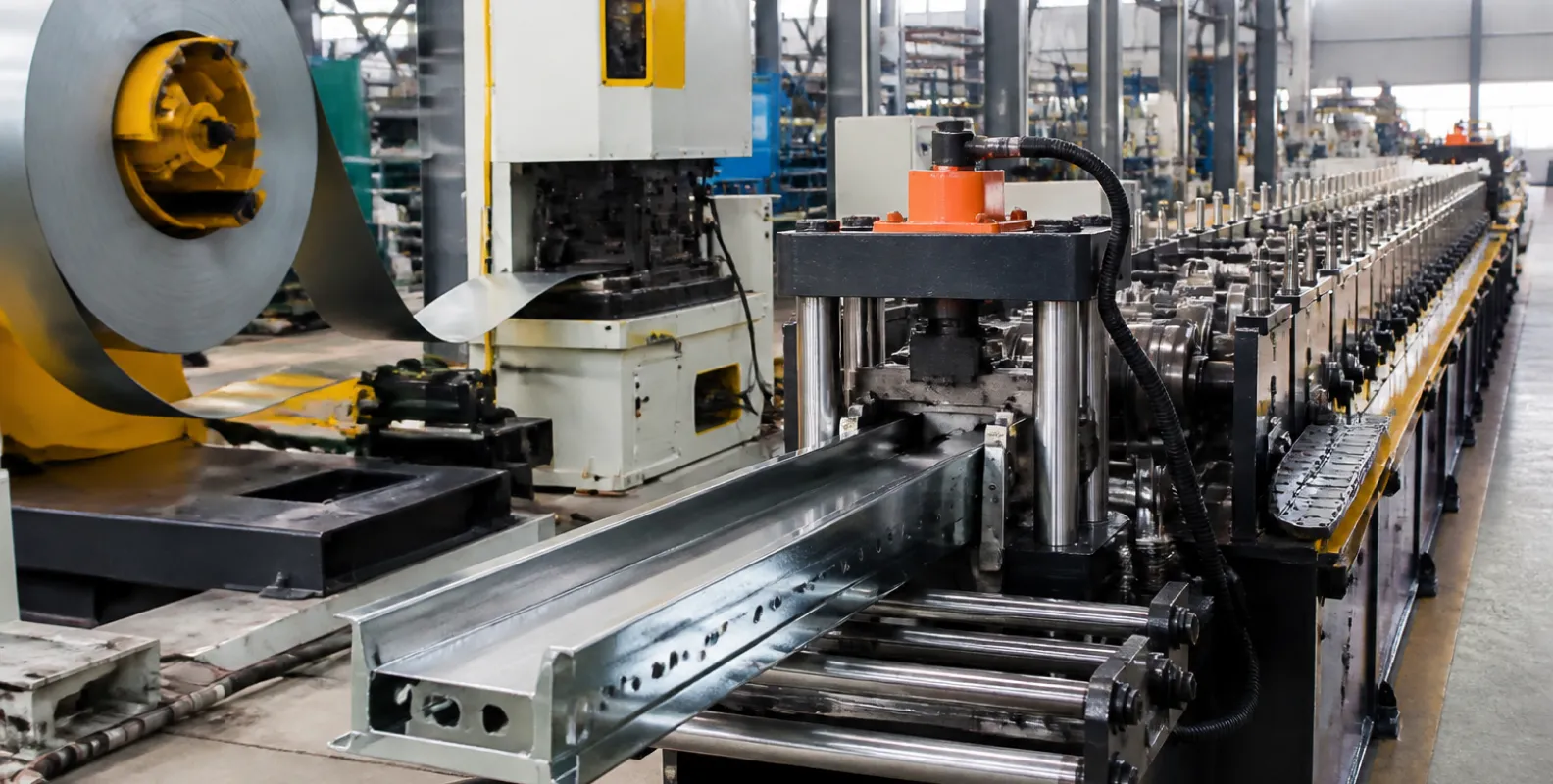
Decoiling, Leveling, and Servo Punching
Production begins with a motorized dual-mandrel decoiler, which feeds the 3-to-5-tonne steel coil into a precision leveler. The leveler uses staggered rollers to eliminate coil set and internal stress. Because uprights require complex perforation patterns down their entire length, the flat strip enters a high-speed servo-driven mechanical or hydraulic punch press. The accuracy of this punching stage is paramount; the center-to-center pitch tolerance between teardrop slots must be maintained within ±0.2 mm over several meters to ensure beams lock level and plumb in the field.
The Roll Forming Mill
The perforated strip proceeds into the storage rack roll forming machine. Producing an Omega upright with deep return bends requires 20 to 26 sequential roll forming stations. The progressive bending distributes the deformation gradually, preventing the pre-punched slots from stretching or distorting. The forming rollers are precision-machined from high-carbon, high-chromium tool steel (such as Cr12MoV or D2) and vacuum-hardened to HRC 58-62 to withstand the abrasive friction of high-strength steel. The foundational mechanics of this incremental bending are explored in our technical overview of what a cold roll forming machine is.
Straightening and Hydraulic Tracking Cut-Off
As the profile exits the final roll station, it passes through a turks head or straightening block to correct any inherent bow or twist caused by material stress release. A hydraulic tracking shear then cuts the continuous profile to the programmed length. The cutting die is custom-profiled to match the complex cross-section of the upright or beam exactly, ensuring a distortion-free cut without crushing the return flanges. The PLC system coordinates the tracking carriage speed with the line speed, allowing for non-stop cutting.
Equipment Configuration and Line Changeovers
A primary operational challenge for racking manufacturers is managing various profile sizes. A standard factory must produce uprights in 80 mm, 90 mm, and 100 mm widths, along with multiple beam depths. Traditional roll forming machines required complete tooling disassembly to change widths, resulting in days of downtime.
Modern industrial lines solve this through cassette-type rafted systems or motorized width adjustment. In a cassette system, the entire forming section (stands, shafts, and rollers) is mounted on a removable base. An overhead crane swaps the entire cassette in under 45 minutes. Alternatively, duplex cantilever machines utilize motorized screw drives to adjust the distance between the left and right forming rolls automatically via the PLC, allowing width changes in minutes without tooling removal. For factories targeting maximum flexibility and uptime, evaluating these rapid-changeover technologies is the most critical phase of capital equipment procurement.
Post-Forming Operations: Welding and Coating
While the roll forming line produces the main structural members, secondary operations are required to complete the assembly. Step beams must have connector brackets (end plates) welded to both ends. These brackets feature the extruded pins or hooks that engage the upright teardrops. This process is typically automated using robotic MIG welding cells in heavy-duty jigs to ensure exact 90-degree alignment. Following welding, non-galvanized components are processed through an automated powder coating line, which applies a durable, high-visibility epoxy finish baked at high temperatures.
Conclusion and Factory Implementation
The production of warehouse storage racks is a highly specialized application of continuous cold roll forming. Meeting the rigorous deflection and buckling standards of international logistics requires high-yield materials, exacting punch tolerances, and sophisticated roll pass engineering. For fabricators, the transition from purchasing generic profiles to investing in an automated upright and beam production line secures supply chain autonomy, controls dimensional quality, and significantly reduces unit costs in high-volume environments.
If you are upgrading your warehouse racking manufacturing facility or require consultation on customized roll tooling for proprietary ASRS profiles, THRONCH engineering teams are available to design a complete, optimized production line. Send us your section drawings and capacity requirements to receive a detailed line configuration proposal.
-

THRONCH
Cold Roll Forming Machine Manufacturer
THRONCH is a direct manufacturer specializing in custom cold roll forming lines and welded pipe mills. With over a decade of engineering expertise, we share technical insights and deliver high-precision